

If you’re searching “how long does an autopsy take in Texas,” you’re probably looking for a clear answer during a stressful or uncertain time.
The truth is simple; but also a bit more complex than most expect.
This guide breaks it down step-by-step so you know exactly what to expect.
These timelines are based on forensic pathology standards in Texas medical examiner systems.

An autopsy isn’t a single event; it’s a multi-stage forensic investigation.
This is the part most people imagine:
Usually completed within a few hours after the body arrives.
Within a day or two, pathologists can often provide:
In Texas, some preliminary conclusions may even be available within 24 hours in straightforward cases.
This is where most of the waiting happens.
Common tests include:
These tests typically take 4–10 weeks or more, depending on complexity.
Once all results are complete:
Most reports take 6 –12 weeks, but complex cases can take months or longer.

Autopsy report timeline may vary even though the physical exam is fast, the investigation behind it is extremely detailed.
Autopsy findings may be used in:
Results must be 100% accurate and defensible
Toxicology is often the biggest delay:
This alone can take 4–6+ weeks.
Some tests involve:
These processes naturally take days to weeks.
Many Texas counties handle large caseloads:
This can push timelines into months in complex cases.
If you need an official report, here’s the process:
You’ll need to contact the office where the death occurred.
Most offices require:
Requests can usually be made:
Some counties charge small fees for:
Typical wait times:
You may not receive a report immediately if:
If you’re writing for readers experiencing loss, include a gentle note like:
“If you’re unsure where to start, the medical examiner’s office can guide you through the process.”
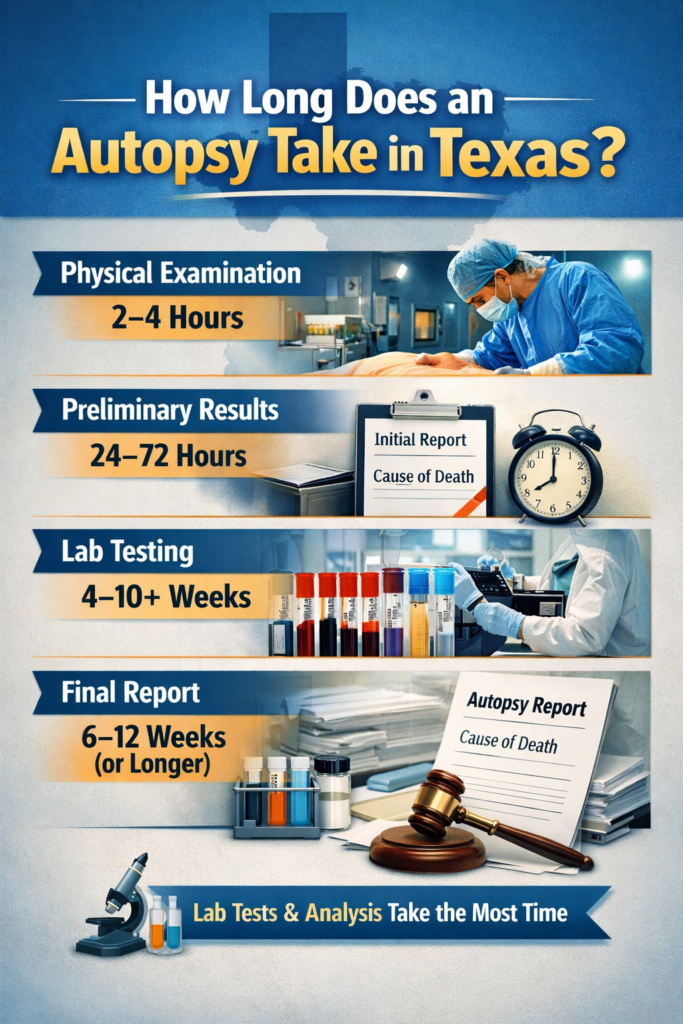
The timeline for receiving autopsy results can vary depending on lab testing and case complexity. According to forensic guidance and medical examiner resources:
Typical timeline:
In Texas:
These timelines depend heavily on case complexity and required testing.
Here are the biggest variables that affect timing:
In rare cases, reports can take several months or more.
Usually within 24–48 hours, since the physical exam is completed quickly.
Because results must be:
If you’re wondering “are autopsy reports public record in Texas,” the short answer is:
Yes; in most cases, autopsy reports are considered public records.
But there are some important exceptions you should understand.
Autopsy reports in Texas are generally accessible under the Texas Public Information Act.
This law allows the public to request access to government records, including:
This is especially true when the case is handled by a county medical examiner.
Autopsy reports in Texas are generally accessible under the Texas Public Information Act.
You can review the official law here:
Texas Law on Autopsy Report
Even though they’re usually public, access can be restricted if:
In these situations, the report may be:

Some counties in Texas provide limited online access, but:
Most full autopsy reports are NOT freely searchable online
Instead, you typically need to:
You can explore one example of a public records portal here:
Public Record Example
Larger counties like Harris County or Dallas County are more likely to offer structured request systems.

To obtain a report, you’ll usually need:
Processing times vary from a few days to several weeks, depending on case status.
Autopsy reports in Texas are generally public
But access depends on case status and legal factors
Understanding this can help you avoid delays and know exactly what to expect when requesting records.
An autopsy in Texas is fast at the surface, slow beneath it.
That delay isn’t inefficiency; it’s precision, science, and legal accuracy at work.
If you’re navigating the difficult moments after losing someone, you don’t have to figure everything out alone.
At Gentlepath Guide, we provide clear, step-by-step resources to help you through:
Explore our complete resource hub here:
GentlePath Guide
If this topic raised more questions, our detailed guides can help you move forward with clarity:
Visit: GentlePath Guide
These resources are designed to make a difficult time feel a little more manageable.